In 2026, AI-made short films are moving from novelty experiments into real advertising. The important shift is not just better generation. It is that creators and brands are already using miniature stories as ad creative.
📅 Published: May 28, 2026
By Maya ChenMay 28, 20269 min readAI video / Advertising / OmniFit
Short version: AI lets teams make cinematic ad worlds faster, but every winning AI short film still needs platform-native versions for YouTube, Shorts, TikTok, Reels, feed, and landing pages.
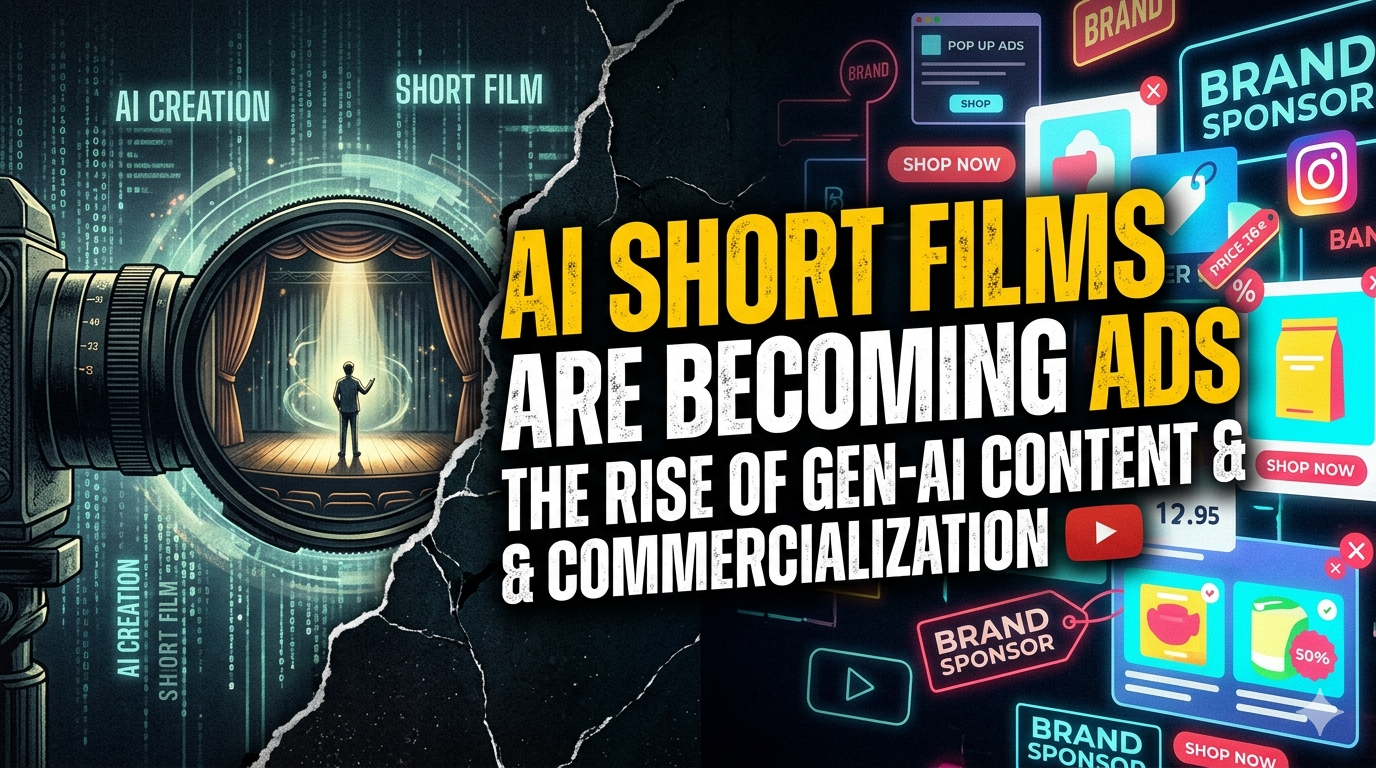
Hero image: AI-generated visual for OmniFit.
What is already happening
Creators and brands are publishing AI-generated short films that function directly as ads. The format looks like entertainment first, then advertising second.
Why it matters for OmniFit
The same AI film rarely lives in one aspect ratio. The distribution step needs outpainting, reframing, and platform-fit versions without damaging the story.
The ad is starting to look less like an ad
Something interesting is happening in video advertising. Instead of a product demo, a founder talking head, or a fast-cut UGC testimonial, more creators and brands are experimenting with AI-made short films: cinematic mini-stories, surreal product worlds, fictional characters, dreamlike scenes, and narrative hooks that feel closer to entertainment than performance marketing.
The important point is that this is no longer only a forecast. We are already seeing adoption: people are publishing AI-generated short films that function directly as ads. They are not just clips with AI visuals added on top. They are short films that happen to carry a commercial message.
That distinction matters, because it points to where AI video advertising is already going in 2026.
Examples: AI short films used as ads
These two examples show the adoption pattern directly. The creative is built like a miniature story first, then functions as advertising through mood, association, and product context. The product or brand message does not have to interrupt the story. It can live inside the world of the short film.
Embedded examples supplied by the post brief. They are useful because they show the creative behavior the article is describing: story-led AI video functioning as ad creative.
What changed in 2026
The first wave of AI video ads was mostly novelty. A brand used AI because the ad was about AI, or because the output looked strange enough to earn headlines.
In 2026, the news is different. AI video is being folded into normal advertising workflows. At Google Marketing Live 2026, Google described new AI-powered video tools for brands and agencies as "a whole new world" for time-poor marketers. The tools are designed to help advertisers build video campaigns from narrative prompts, generate storyboards, edit scenes, and render creative assets inside Google Ads workflows.
At the same time, MediaScience released a 2026 study finding that labeling a video ad as AI-generated did not hurt ad performance across the conditions it tested. That matters because one of the biggest brand fears has been: will people reject the ad if they know AI helped make it?
YouTube is also making AI labels more visible and rolling out automatic detection for some realistic AI-generated videos. Platforms are preparing for a world where synthetic video is common enough that disclosure cannot rely only on creators manually checking a box.
Put together, the signal is clear: AI video tools are entering mainstream ad platforms, brands are testing AI-labeled ads, platforms are preparing viewers, and short-form entertainment formats are proving that AI can produce narrative video at volume.
Why short films are such a natural format for AI ads
AI video has a weakness: it can struggle with long, controlled continuity. But short ads do not always need long continuity. They need a fast hook, a memorable world, and a clear emotional impression. That makes short-film advertising a surprisingly good fit for generative video.
An AI short-film ad can be built around:
A surreal product metaphor
A fictional founder story
A tiny cinematic scene
A dream sequence
A before-and-after transformation
A character discovering a product in an exaggerated world
A visual joke that would be too expensive to shoot physically
This is why AI video works especially well for speculative ads, mood films, launch teasers, and paid-social tests. The goal is not always to show the product literally. Sometimes the goal is to make someone stop scrolling long enough to feel something about the brand.
MIT Technology Review's 2026 reporting on Chinese short dramas shows the broader content-machine logic behind this shift. Short dramas are already designed for mobile viewing, serialized hooks, and high-volume testing. That same logic maps cleanly onto advertising: performance marketers already test many hooks, many edits, and many audiences. AI short films make it easier to test many worlds.
What brands are really buying: speed, variation, and story worlds
The obvious benefit of AI video is lower production cost, but that is only half the story. The bigger change is creative variation.
A traditional brand film is expensive because every new version means more planning, shooting, editing, and approvals. With AI, a small team can test several creative directions before choosing one:
The same product in a sci-fi world
The same message as a nostalgic mini-film
The same offer told through comedy
The same campaign localized for another market
The same scene reframed for vertical mobile viewing
That makes AI short-film ads attractive for small brands that could never justify a full commercial shoot, and for larger brands that need more creative assets for testing.
Google's 2026 Asset Studio announcement points in this direction. The workflow described is not just "generate one video." It is prompt, storyboard, swap scenes, change flow, render, and test. That is the language of campaign iteration.
The hidden problem: every AI ad still needs platform-native formatting
This is the part people underestimate. AI makes it easier to produce a cinematic ad. It does not automatically solve distribution.
A short-film ad might begin as a 16:9 cinematic piece for YouTube or a website landing page. But if it performs, the brand will want versions for every major channel.
Channel
Best-fit format
Common use
YouTube video
16:9
Full short film, launch film, brand story
YouTube Shorts
9:16
Hook-first cutdown
TikTok
9:16
Trend-native paid or organic version
Instagram Reels
9:16
Vertical story cut
Instagram feed
1:1 or 4:5
Teaser or product moment
LinkedIn
16:9 or 1:1
Founder or product narrative
X / Twitter
16:9 or 1:1
Short teaser, launch moment
Most teams will not regenerate the entire film from scratch for every format. They will adapt the winning creative. That is where bad formatting can quietly ruin a good AI ad. A 16:9 cinematic scene cropped into 9:16 may cut off the world-building that made it feel premium. A vertical AI film dropped into a horizontal YouTube player may end up with black bars. A square crop may remove the product, character, or visual punchline.
For AI short-film ads, formatting is not a mechanical export step. It is part of preserving the illusion. If the viewer notices the crop, the story breaks.
Where OmniFit fits into the AI ad workflow
OmniFit is not an AI film generator. That is the point. The AI generation tool helps make the film. OmniFit helps that film survive the platform jump.
For creators and marketers experimenting with AI short-film ads, the practical workflow looks like this:
Generate or edit the strongest master version of the short film.
Pick the primary canvas: usually 16:9 for cinematic brand films or 9:16 for mobile-first ads.
Use OmniFit to outpaint the master into the missing platform formats.
Create cutdowns for each channel.
Test hooks and captions without rebuilding the whole visual world.
This matters most when moving between opposite formats: 16:9 to 9:16, 9:16 to 16:9, and either format into square or 4:5 feed placements.
Cropping can work for simple talking-head footage. But cinematic AI ads often depend on the edges of the frame: background details, atmosphere, world-building, props, text, or visual symmetry. Outpainting is a better fit when the frame itself is part of the concept.
What creators should do now
If you are a creator, editor, or small brand experimenting with AI video, do not treat the generated clip as the final asset. Treat it as the master.
Before you publish, ask:
What is the hero format for this idea?
What formats do I need if it performs?
Can the subject survive a crop?
Are the edges important to the story?
Does the vertical version still feel cinematic?
Does the horizontal version still feel intentional?
The best AI short-film ads in 2026 will probably not be the ones with the strangest visuals. They will be the ones that feel native wherever they appear.
Make the AI film travel
Once you have a strong AI short film, OmniFit helps adapt it for the platforms where it needs to perform: YouTube, TikTok, Shorts, Reels, feed, and landing pages.
Yes. In 2026, the broader advertising industry is moving AI video into campaign workflows, and creators are increasingly making cinematic AI videos that function as commercial pieces.
Will audiences reject ads if they know AI made them?
Not necessarily. A 2026 MediaScience study found that AI-generated video ad labels did not hurt measured ad performance across tested label formats.
Why are AI short films good for advertising?
They are fast to produce, easy to vary, and good at creating visual worlds that would be expensive to shoot. They also match the way modern ads are tested.
How does OmniFit help?
OmniFit outpaints video into new aspect ratios, so creators can adapt an AI short film without relying only on crop or black bars.
Sources and 2026 signals
B&T
Google's 2026 AI video tools for time-poor marketers and Google Ads creative workflows.