
This was not just a founder vs investor spat
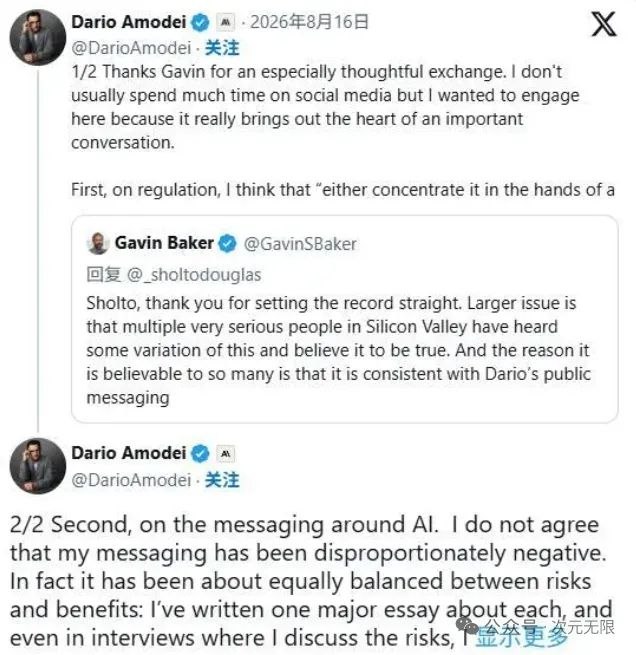
The exchange matters because it captures the sharpest contradiction in AI right now. The industry wants trust, fast adoption, lighter political resistance, and huge market upside at the same time. But those goals do not always fit neatly together.
One side says constant warnings about catastrophic risk can be used by opponents of AI infrastructure, stricter permitting, and broader deployment. The other side says the industry has already overused big promises and still has not earned enough trust from normal people.
Public resistance to AI is not only fear of the technology itself. It is also a trust deficit: people do not automatically believe that powerful companies will use AI in ways that clearly improve ordinary lives.
Gavin Baker’s criticism: too much doom talk can backfire
In the version of the exchange summarized above, Baker’s complaint is not that AI risk is fake. His complaint is that repeated public emphasis on existential danger can create real political and social costs for the whole industry.
- Anti-AI groups can point to those warnings as proof that even insiders think the technology is dangerous.
- In a period of intense valuation and IPO speculation around Anthropic, negative framing can look strategically self-defeating.
- He also pushes a familiar Silicon Valley line: regulation often turns into regulatory capture, which can end up protecting the biggest incumbents instead of constraining them.
That argument is easy to understand. If you believe AI should be broadly distributed, you worry that heavy rules will lock advantage into the hands of the best-funded labs and cloud giants.
His answer is blunt: the real problem is credibility
Dario’s response, as described in the summary above, is that public backlash cannot be explained away as a messaging mistake. In his framing, the deeper issue is that many people already distrust both large companies and the tech industry more broadly.
That is why simply asking AI leaders to sound more upbeat is not enough. If the industry keeps repeating huge promises without showing enough concrete public benefit, better marketing will not fix the underlying problem.
His sharpest point is also the most memorable one: saying “AI will cure cancer” is easy. Actually helping cure cancer is what would change people’s minds.
The industry has a promise gap
That is the part of this debate that goes beyond Anthropic. AI companies have become extremely good at selling scale, speed, capability jumps, and world-changing future impact. But for many people outside the industry, the visible lived result is still fuzzy. They hear giant claims. They do not yet see giant everyday payoff.
Dario rejects the simple “regulation = monopoly” story
Another major part of the exchange is about regulation. A common argument in AI circles says the chain is simple: regulation leads to capture, capture leads to concentration, and concentration leaves frontier power in the hands of a few giant firms.
Dario’s reply is more institutional. Outside Silicon Valley, many people do not see regulation as a gift to elites. They see it as one of the few tools capable of limiting elite power. That does not mean every rule will work well. It means the “any regulation automatically helps incumbents” story is too convenient and too simple.
- He appears to support tighter obligations for frontier models than for smaller players.
- He appears open to regulatory room for open models and challengers, while still acknowledging that open access alone does not erase power concentration.
- He treats compute, chips, and capital as structural concentration forces even if model weights become more available.
This is also a story about what AI leaders are allowed to say during hype cycles
The timing matters. Anthropic sits in the middle of intense market excitement, recurring valuation chatter, and constant comparison with other frontier labs. In that environment, there is a natural incentive to sound bullish, commercial, and relentlessly positive.
But Dario’s public posture has often been more mixed. He talks about upside and risk together. That makes him unusual in a sector where many people would rather emphasize acceleration, productivity, and national-competition narratives than talk too much about loss of control, misuse, or concentration of power.
That is why this argument feels bigger than one exchange. It raises a hard question for every major AI company: when capital markets want a clean growth story, how much candor about risk can a leader really afford?
The trust crisis probably will not be fixed by messaging alone
If the summary above is right, Dario is making a point the whole sector should take seriously. Public trust usually does not come from hearing that a company is visionary. It comes from seeing that the company’s power produces visible, broadly shared benefit without obvious abuse.
That means two things can be true at once:
- Yes, constant apocalyptic rhetoric can be politically costly.
- But no, the credibility problem will not disappear just because executives start sounding happier in interviews.
In other words, better storytelling may help at the margin. Real trust probably comes from real delivery.
The real fight is not optimism vs pessimism. It is legitimacy vs disbelief.
This debate is not just about tone. It is about whether the AI industry has earned the right to ask for public trust while it keeps expanding power, infrastructure, and influence. If ordinary people believe the upside will stay private while the disruption becomes public, the trust problem will keep growing.
That is why this exchange matters. It reframes the question from “Should AI leaders sell the future harder?” to something more uncomfortable: “What has the industry actually done so far that a skeptical public should trust?”
Note: this post is an English adaptation of the Chinese summary provided above and uses the two supplied images as supporting visuals. Some business-timing language has been softened where the summary referenced IPO and valuation claims that are not independently documented inside the provided materials.