
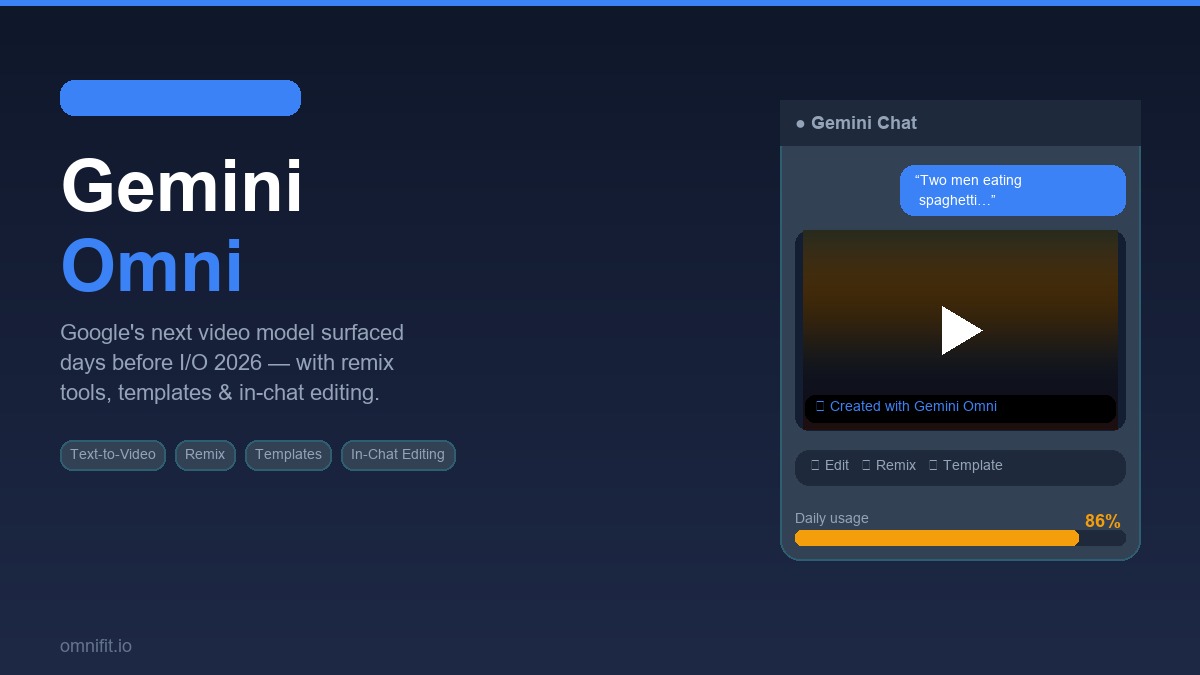
Gemini Omni showed up early. Here is what people saw.
According to reports from 9to5Google and Chrome Unboxed, at least one Gemini user was prompted to "Create with Gemini Omni" — a new video generation model that had not been publicly announced yet.
Google describes it as a way to remix your videos, edit directly in chat, and try out pre-made templates. While the exact relationship between Omni and the existing Veo model is not entirely clear, metadata from the leak suggests Omni might be an extension or evolution of the Veo foundation — repackaged for a more accessible, chat-native experience.
The spaghetti test, and why it matters
If you remember the early days of AI video, you probably remember the horrifying viral clip of Will Smith eating spaghetti. It became the unofficial benchmark for how bad AI video could be — warped faces, melting food, fingers that multiplied.
One of the leaked Omni demos specifically used a prompt for two men eating spaghetti at an upscale restaurant. The results were incredibly realistic. Hands moved naturally. The food looked like food. The faces held together.
Another demo featured a professor writing out a mathematical proof for trigonometric identities on a traditional chalkboard while explaining the steps. While there are still some visible AI artifacts, the model handles text generation and physical movements remarkably well — two things that have been notoriously difficult for video models.


Why this leak says more than the demos
Not a separate app. Not a studio. Gemini Omni puts video generation directly in the conversation — remix, edit, and generate where you already work.
Pre-made templates mean Google is targeting everyday users, not just AI researchers. This is a consumer play — quick video for social, presentations, messages.
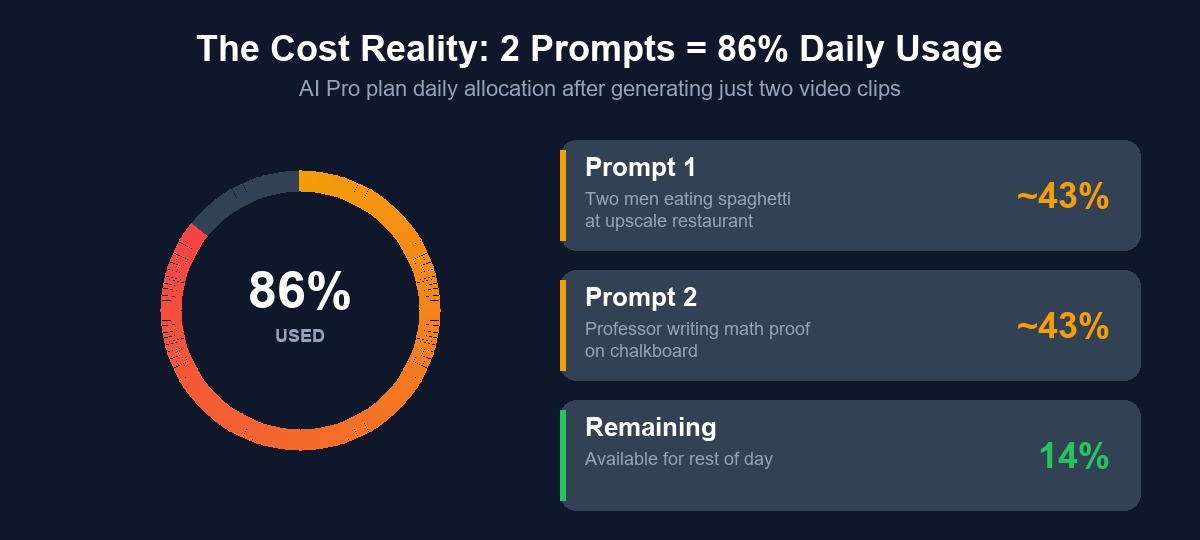
The leaker burned through 86% of their daily AI Pro usage generating just two video prompts. Google is clearly aware of the compute cost and is building explicit usage caps.
"Omni" suggests this is positioned as a unified, do-everything model — not a specialist tool. Google may be converging text, image, and video generation under one brand.
Capabilities spotted in the leak
Based on the leaked prompts, UI elements, and demo outputs, here is what Gemini Omni appears to offer:
86% of daily usage on two prompts
This is the part that should temper the excitement. The user who spotted the Omni features also noticed a new "usage" tab on their account. Generating just two video prompts consumed 86% of their daily allocation on an AI Pro plan.
Google has recently been spotted preparing more explicit usage limits for Gemini across tiers. A compute-heavy model like Omni is likely the exact reason why. For creators who want to iterate quickly — generating five, ten, twenty variations of a shot — the current limits could be a real constraint.
- Two video generations = 86% daily usage on AI Pro
- That means roughly 2–3 video clips per day at current limits
- Heavier workflows will likely require the Ultra tier or top-up credits
- Google is building a usage dashboard to make limits transparent
Where does this leave Veo and Flow?
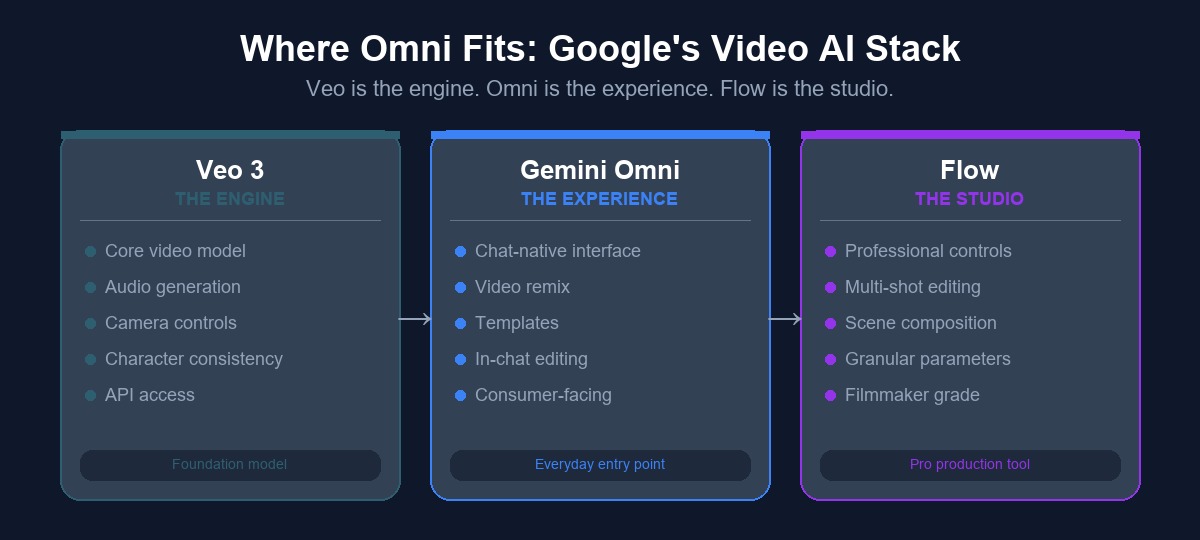
Google already has Veo 3.1 — a powerful video model with native audio, character consistency, outpainting, and camera controls — available through Flow and the Gemini API. So where does Omni fit?
The most likely reading: Veo is the engine, Omni is the experience. Veo powers the generation. Omni is the consumer-facing wrapper that makes it feel like a chat feature rather than a production tool. Flow stays as the filmmaker-grade studio. Omni becomes the everyday, everyone-can-use-it entry point.
If that is the split, it makes strategic sense. Flow serves professionals who want granular control. Omni serves the vastly larger audience who just wants to say "make me a video of this" in a chat box and get something usable back.
Google I/O is days away
With I/O 2026 right around the corner, it is a near certainty that Gemini Omni will get official stage time. Here is what to watch for:
The leak shows a subset. Expect Google to announce the full feature set — likely including audio generation, longer clips, and more editing controls.
How many videos per day on Free, Pro, and Ultra? This will determine whether Omni is a toy or a tool for real workflows.
Does Omni replace Veo in Gemini? Does it use the same underlying model? The naming and positioning will clarify Google's video strategy.
Developers will want to know if Omni capabilities are available through the Gemini API — or if this is a Gemini-app-only feature.
What to do right now
- Do not panic-switch tools. This is a leak, not a launch. Wait for the I/O announcement to see the real feature set and limits.
- If you have Gemini AI Pro, check whether Omni prompts are showing up for you. Some users are getting early access.
- Keep an eye on the usage dashboard. The 86% daily burn rate on two prompts tells you a lot about what iteration will cost.
- Compare against your current workflow. The question is not whether Omni is impressive. It is whether chat-native video generation fits how you actually make things.
- Watch Google I/O. The official announcement will clarify pricing, limits, and whether this is a Veo rebrand or a genuinely new model layer.
The spaghetti test was always a joke about how far AI video had to go. The fact that Omni passes it — casually, in a leaked demo — says something real about where this technology is now. The question left is not quality. It is access, cost, and whether Google can make video generation feel as natural as asking a question in chat.
What this post is grounded on
First reported the Gemini Omni model leak with early demo videos showing the spaghetti test and chalkboard demos (May 11, 2026).
Provided additional context on the "Create with Gemini Omni" prompt, usage limits, and the Veo relationship (May 11, 2026).