
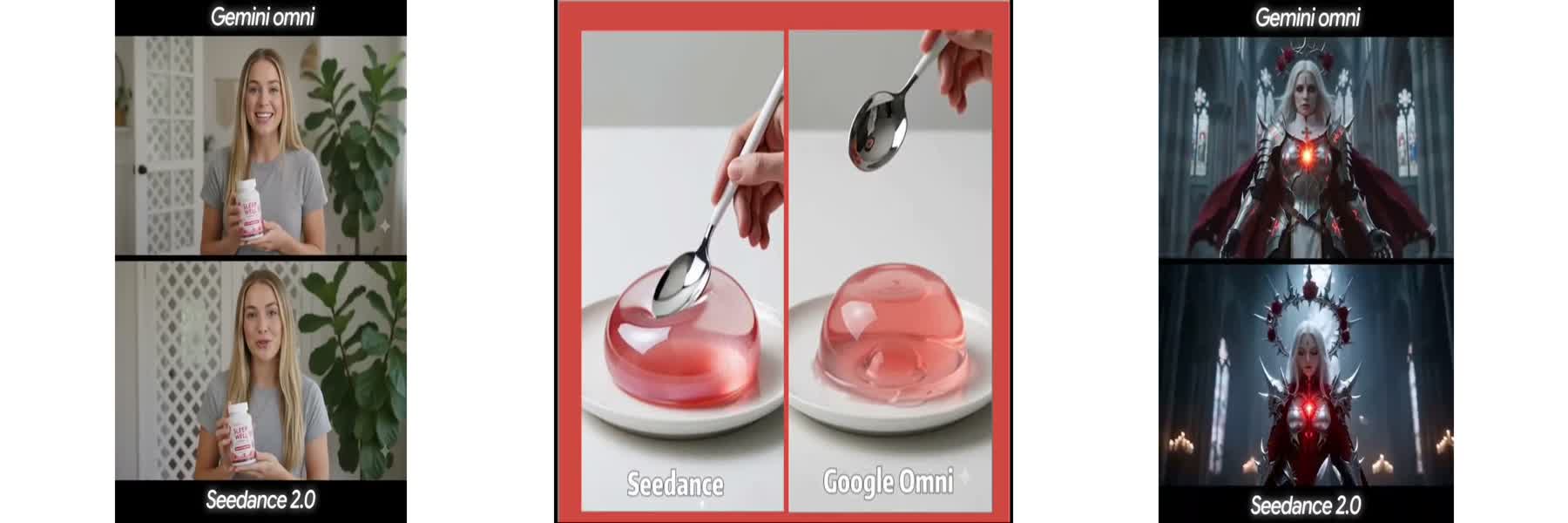
Three short prompts, one simple question
This was not a lab benchmark. It was a practical creator test: give both models a few prompts that feel normal for AI video work, then watch where each one feels stronger.
The three side-by-side videos
Very close result
This one felt like a draw. Both models handled the scene well enough that it was hard to argue for a clear winner from a creator point of view.
- Both clips looked stable.
- Both felt simple enough for the models to solve.
- If this is your main use case, the gap may not matter much.
Omni feels a little stronger on physical understanding
This was the test where Gemini Omni had the clearest edge. The difference was not massive, but Omni looked a bit better at understanding how the spoon should press and deform the jelly.
- The motion looked more believable.
- The interaction felt less random.
- If you care about object physics, Omni looks slightly more trustworthy here.
Both models follow surprisingly well
The last test used a much more detailed gaming prompt. Here, both models followed the brief well and both showed strong creativity.
- Both handled complexity better than expected.
- Both stayed creative without losing the scene.
- This test did not produce an obvious winner either.
Where each model stood out
Both models looked good enough that the practical difference was minimal.
Omni felt more grounded when the action depended on contact and deformation.
Both followed a detailed prompt well and both kept a strong creative feel.
The bigger pattern matters more than the winner
If you only look for a dramatic winner, these tests may feel inconclusive. But that is also the point: Seedance is competitive in straightforward and highly styled prompts, while Gemini Omni starts to feel more convincing when the model has to understand how things should behave in the physical world.
That makes Omni especially interesting for prompts involving hand actions, object manipulation, food, materials, or any short shot where believable interaction matters more than pure visual flair.
What creators should take from these clips
- If your shots are simple, both models are already strong enough to be useful.
- If your prompt depends on physical interaction, Gemini Omni looks a little more reliable.
- If your prompt is detailed and imaginative, both models can still produce strong creative results.
- The smartest workflow is probably not picking one winner forever. It is knowing which prompt types expose each model's strengths.