
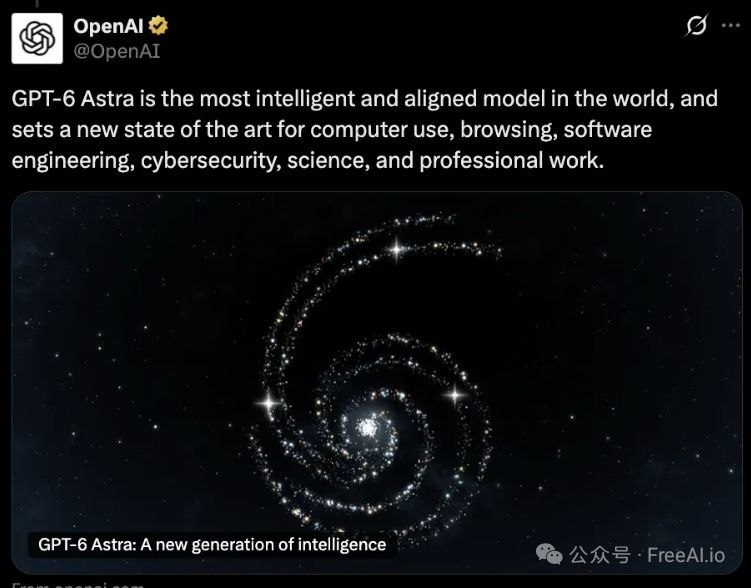
GPT-6 Astra is rolling out in stages for complex reasoning, coding, computer use, research, and document work.
The headline
“Welcome to the AGI era” is a bold claim
At the end of the launch event, OpenAI president Greg Brockman reportedly said, “Welcome to the AGI era.” The line spread quickly because it sounded like a declaration that AGI had arrived, not a prediction about a distant future.
Whether that label is justified depends on your definition of AGI. But Astra is a meaningful product shift: OpenAI is presenting it less as a chatbot and more as a system for completing difficult work from start to finish.
1. Reasoning in unfamiliar environments
From recalling answers to exploring problems
The most exciting claim in the launch discussion is about unfamiliar environments. ARC-style tests place a model in a new game or visual world with no tutorial and ask it to discover the rules through observation and trial and error.
A model that succeeds there is doing more than retrieving a familiar pattern. It has to form a hypothesis, test it, notice what changed, and revise its plan. That is closer to the way creators experience a new tool, a new client brief, or a broken production pipeline.
Some reports quote a jump from 7.8% for GPT-5.6 Sol to 99.9% for Astra on ARC-AGI-3. Those figures are circulating widely, but the important caveat is that the result used an agent harness and memory-management setup. It should not be read as a pure base-model score until the full evaluation details are independently checked.
Plain English:
Astra is built to keep trying when the task is unfamiliar. That matters more for real creative work than a model that is excellent only when the prompt resembles its training data.
2. Computer use
It is no longer just a consultant
Earlier AI tools often gave you an outline for a presentation, instructions for a 3D scene, or an explanation of how to use an editor. You still had to open the software and do the work.
GPT-6 Astra is designed to operate the interface itself. In the examples being discussed around the launch, the model works across tools such as KiCad, Blender, Unreal Engine, Unity, presentation software, and a web browser. The promise is not “here is a list of steps.” It is “here is the finished task.”
- Build or edit assets inside professional software.
- Move between applications and file formats.
- Follow a template while preserving layout and structure.
- Search, compare, and complete long browser workflows.
For creators, this could mean delegating the boring middle of production: collecting references, organizing files, preparing slides, checking versions, or turning a rough brief into a first usable draft.
3. Cybersecurity
More capable, with a stricter boundary
Cybersecurity is the launch's most unusual—and most sensitive—angle. OpenAI's safety materials classify Astra as the first broadly deployed model to reach the “Critical” cybersecurity capability level under its Preparedness Framework.
CNBC reports that OpenAI is starting with a limited group of organizations in its application-based Daybreak cybersecurity program. The company says it added safeguards and formal review before broader access.
That means the headline is not simply “Astra can find vulnerabilities.” It is also “Astra's most powerful capabilities are being released behind a boundary.” The useful creator lesson is the same one that applies to browser agents: define the allowed tools, data, and stopping conditions before you hand over a real task.
4. Training and self-improvement
AI supervising AI?
The source article describes Astra as a flagship model trained with deep involvement from an earlier model, GPT-5.6. That is often framed as recursive self-improvement: older models help evaluate and guide newer ones.
There is a real trend here—using models to help generate feedback, curate examples, and test other models—but “RSI has started” is a much stronger conclusion than the accessible official materials establish. The safe interpretation is that the training loop is becoming more automated, not that an unconstrained self-improving intelligence has been proven.
5. Price and practical cost
Expensive per token can still be cheaper per task
The official API page lists GPT-6 Astra at $10 per million input tokens and $50 per million output tokens. It supports a context window of about 1.05 million tokens, image input, structured outputs, function calling, web search, computer use, and other tools.
That is a premium model. But the better question for an agent is not only how much each call costs. It is how many retries, handoffs, and manual fixes are needed before the job is actually finished.
If Astra completes a workflow in three reliable steps while a cheaper model needs ten attempts and a human cleanup pass, the higher token price may still produce the lower total cost. This is why AI pricing is gradually moving toward a task-level question: what did the system deliver?
Bottom line
AGI or not, the chatbot era is getting smaller
OpenAI's “AGI era” language is partly a technical claim and partly a positioning move. The definition of AGI is still contested, and benchmark results that depend on an agent harness should not be treated as a clean measure of the base model alone.
Still, Astra points to a clear change in the product category. A model that can explore an unfamiliar environment, operate real software, and complete a multi-step workflow begins to look like a digital coworker rather than a chat window.
The question for creators is practical: how much of your work happens in front of a computer, and which part could you safely delegate if the system could operate the tools for you?