
Kling motion transfer: complex moves and character swaps in 2 short tests
Most motion-transfer demos only prove that a character can wave, nod, or do one easy dance loop. These two clips are more useful. One asks Kling to carry a skating performance with balance changes and rotational movement. The other asks it to apply one cute dance pattern across very different subjects, including a stylized girl and an upright dog.
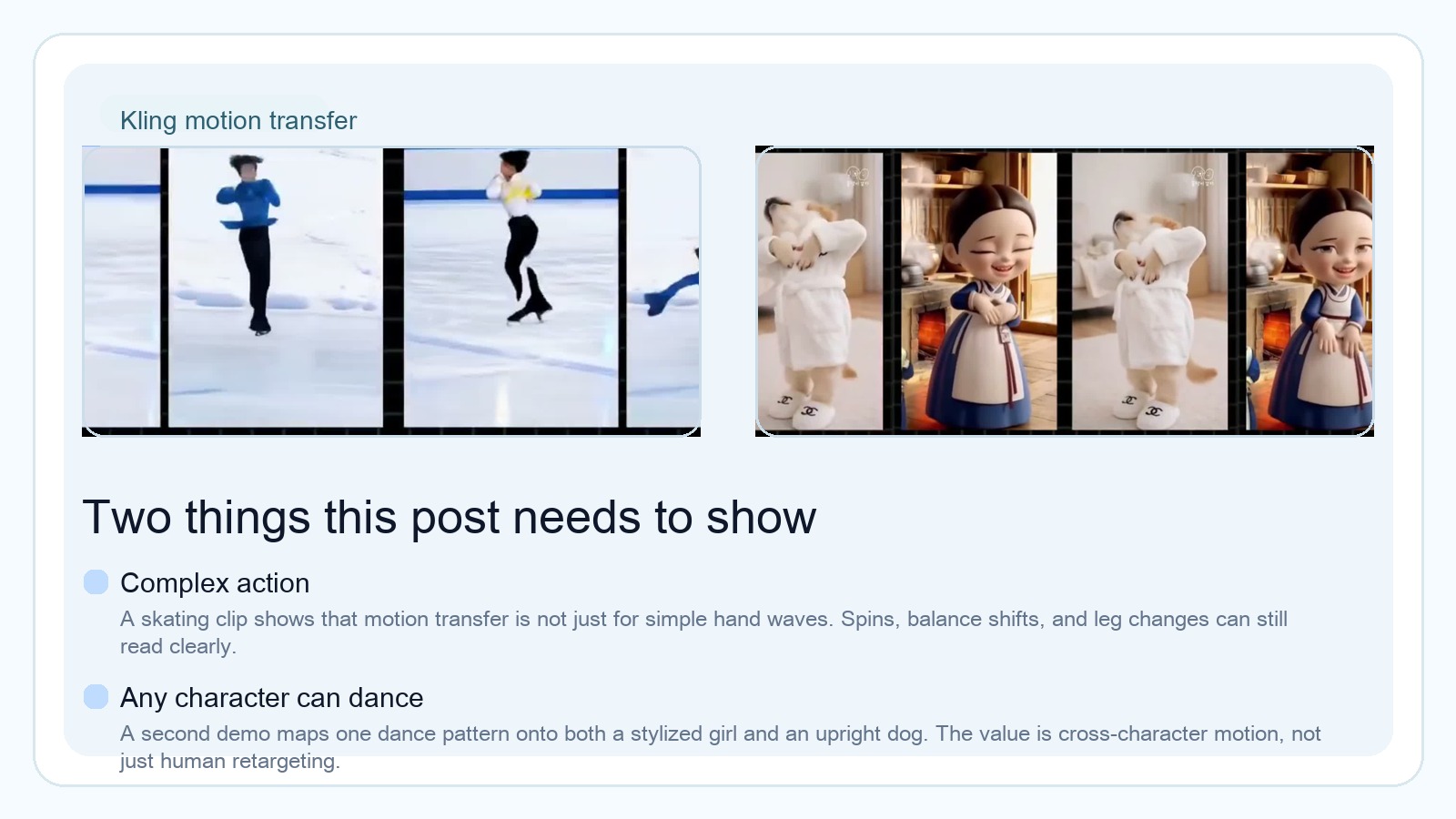
The skating clip suggests Kling can hold on to trickier timing, balance shifts, and rotational movement instead of collapsing into a generic sway.
The same movement reads on both a stylized human-like character and an upright dog, which is exactly the kind of flexibility creators want for meme-ready or brand-character content.
If you want cleaner results, keep the clip short, the motion reference clear, and the scene centered on one performer before you try harder multi-character cases.
These are better tests than the usual “look, it moves” demo
For creators, motion transfer only becomes interesting when it helps in real work. That means two things: it should handle more than a toy gesture, and it should let you reuse one reference performance across very different characters. These two clips map neatly onto those two jobs.
- Skating is useful because it stresses rhythm, rotation, and body control instead of only arm motion.
- The dance swap is useful because it tests retargeting range, not just human realism.
- Together they tell a clearer story: Kling motion transfer is strongest when you treat it as a way to borrow movement structure, not as magic full-scene choreography.
The skating clip is the real proof point
If motion transfer falls apart, it usually happens when the body has to do more than bob in place. This clip is useful because skating creates faster balance changes, cleaner edge shifts, and more visible full-body timing than a simple talking-head or idol pose loop.
- It asks Kling to preserve rotational feel instead of only front-facing movement.
- It makes leg timing matter, not just hand motion.
- It shows why motion transfer can be worth testing for sports, dance, and performance-style clips.
The dance clip shows why creators care about retargeting
The second test is not about realism. It is about portability. One compact dance move gets mapped onto multiple subject types, including a stylized girl and an upright dog, and the core rhythm still reads. That is the kind of behavior people want for mascot content, meme formats, and character experiments.
- The useful question is not “does it look human?” but “does the motion stay recognizable?”
- It suggests the same motion reference can power several creative variants quickly.
- It also hints that non-human characters can work when the pose language is clear and the scene stays simple.
What creators should test next
These clips point to a practical evaluation flow. Start with one clear reference clip, one centered subject, and one job for the motion. Then scale difficulty step by step.
- Try one harder action class like skating, fighting, acrobatics, or fast dance turns.
- Try one subject-transfer class like human → mascot, animal, toy, or stylized avatar.
- Watch for whether the timing and pose logic survive, not whether every pixel stays perfect.
- If the move is breaking, shorten the reference and simplify the framing before blaming the whole workflow.
Character-led short clips
Motion transfer becomes much more valuable when you want to reuse one performance across several identities, costumes, species, or mascot-style characters.
Two-person scenes and long dialogue
The moment the shot needs relationship staging, longer acting beats, or multiple bodies staying coherent, the test becomes much harder.
Kling looks most interesting as a motion-structure tool
The strongest reading from these two clips is simple: use it to transfer motion logic, not to solve every creative problem in one pass.