
What actually shipped
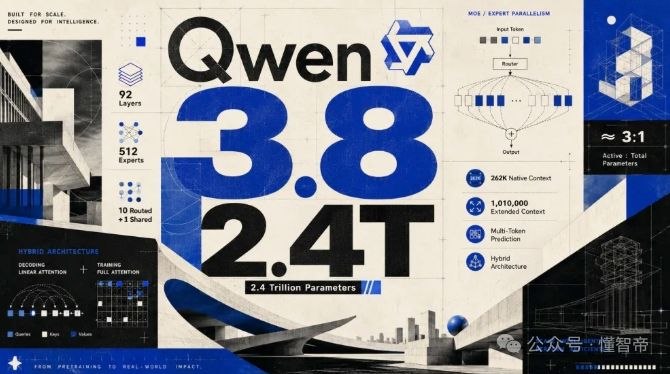
The official record now lines up across three live sources. The Qwen launch post announced Qwen 3.8-Max on August 2 and said open weights would follow the next week. The Hugging Face model card is now live for Qwen/Qwen3.8-2.4T-A95B. And the QwenCloud model page shows what still belongs to the managed Max product.
| Claim | What the live sources confirm | Why it matters |
|---|---|---|
| First Max-class open release | The Hugging Face card explicitly says this is the first time Qwen has brought a Qwen-Max-class model to open release. | That makes this more important than a normal incremental checkpoint update. |
| Hybrid architecture | The model card lists a 23 × (3 × (Gated DeltaNet → MoE) → 1 × (Gated Attention → MoE)) layout, plus multi-token prediction. |
The frontier recipe is shifting toward hybrid attention plus sparse activation, not plain dense Transformer scaling. |
| Very long context | Hugging Face lists 262,144 native tokens and extension up to 1,010,000. QwenCloud shows 1M context and 262K max reasoning on the managed service. | That matters for repo-scale coding, long documents, and tool-heavy agents. |
| Cloud product still does more | The open model card says managed Qwen3.8-Max adds features like vision input, non-thinking support, 1M context by default, and official built-in tools. | Open weights are real, but they are not the entire commercial stack. |
Conservative read: the release is real and substantial, but the smoothest multimodal + tool-using experience still appears to live on QwenCloud.
Watch one good technical review
Why creators should care
If you run an AI-video workflow, you also run prompts, research, scripting, automations, docs, client notes, assets, and tool glue. A stronger open reasoning model helps on the operations side of creative work.
The official Qwen post does not pitch Qwen 3.8 as a chatbot upgrade only. It pushes long-horizon coding, closed-loop feedback, and multi-step task completion. That is the same direction many creator teams want for internal assistants and production helpers.
The numbers in the open card and the launch poster point to a broader market shift: sparse expert routing, hybrid attention, longer context, and multi-token prediction are becoming normal. That means future differentiation may come more from tooling, compute, data, and product fit than from one magical new block diagram.
The open release is important, but the official sources also make clear that the managed Max product keeps built-in tools and richer multimodal behavior. For teams that just want results fast, cloud convenience still matters.
One practical translation of the original Chinese angle
In simple English, the original point is this: Alibaba did not just release a giant model. It also showed that the top Chinese frontier-model playbook is becoming more standardized. Bigger MoE systems, smarter routing, much longer context, and stronger agent behavior are now starting to converge into one mainstream design direction.
That matters because the next fight may be less about who invented the most exotic architecture, and more about who can run the model cheaply, feed it better real-world data, and turn it into useful products people will actually pay for.
What is still unclear
How practical local deployment really is
The open weights are out, but a 2.4T model is still a very different thing from a casual local install. The release is meaningful for advanced teams, infra operators, and researchers first.
How close open inference gets to cloud behavior
The official model card directly says the managed Max service offers more features. So the important question is not just whether the weights exist, but how much product value still sits above the weights.
Benchmark strength is not the same as workflow fit
The Qwen materials lean heavily into coding and professional work. That is promising, but teams still need hands-on testing for their own repos, documents, and toolchains.
The real business moat may move upward
If frontier architectures keep converging, then the bigger moat may come from product surface, orchestration, private data, distribution, and trust — not from headline parameter count alone.
Bottom line
Qwen 3.8 is a real milestone for open frontier models: a Max-class release, a huge MoE system, long context, agent-first positioning, and a live Hugging Face checkpoint people can actually inspect. But the deeper story is market convergence. The flagship recipe is stabilizing, so the next winners may be decided less by architecture novelty and more by execution.
Sources used for this post
Used for the August 2 launch framing, the 2.4T announcement, and Qwen’s official positioning around coding, work, research, and long-horizon tasks.
Read sourceUsed for the open-weight confirmation, 95B activated parameter count, 92 layers, 512 experts, 10 routed + 1 shared, hybrid layout, MTP, and native / extended context numbers.
Read sourceUsed for the managed-product view: 1M context, 262K max reasoning, multimodal inputs, and built-in tools that still sit above the open weights.
Read sourceUsed as the companion video because it includes first-look evaluation and practical technical testing rather than only launch hype.
Watch video